
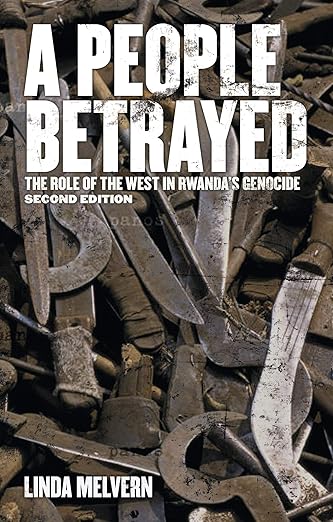
Few works do this as powerfully as Linda Melvern’s A People Betrayed: The Role of the West in Rwanda’s Genocide. Updated in 2024, this work of investigative journalism is far more than a historical account —it exposes how the international community, particularly Western powers and the United Nations, failed a people facing extermination in full view of the world.
Melvern, who has spent more than thirty years poring over declassified archives, leaked documents, abandoned Rwandan military files, and the 2022 trial evidence of alleged genocide financier Félicien Kabuga, leaves no room for denial.
Drawing on decades of research, including declassified archives, leaked documents, Rwandan military files, and evidence from Félicien Kabuga’s 2022 trial, Melvern presents an irrefutable case. She traces the genocide from its colonial roots—when Belgian and German rule entrenched ethnic divisions—through post-independence violence, the 1990 RPF invasion, and the rise of the Akazu elite.
The flawed Arusha Accords and systematic preparations for mass killing reveal that the genocide was deliberate, not spontaneous.
Melvern details how extremists organised militias, imported weapons, and used RTLM radio to incite hatred, portraying Tutsi as enemies to be eliminated. Despite clear warnings—including UN commander Roméo Dallaire’s urgent alerts and a CIA prediction that half a million could die if war resumed, the world chose not to act.
Using a leaked 155-page transcript of secret UN Security Council meetings, Melvern proves that in the first four weeks—while up to 10,000 people were being killed every day—the word “genocide” was avoided.
The United States pushed to withdraw peacekeepers, Britain supported minimal intervention, and France—after backing the Habyarimana regime—established a “safe zone” that effectively protected perpetrators. This failure, as Melvern demonstrates, stands among the greatest moral collapses of the 20th century.
Yet the book also honours acts of courage: Dallaire’s small UN force, Rwandans who sheltered others, and aid workers who stayed. It concludes with reflections on the Genocide Convention and includes an appendix mapping key memorial sites. The 2024 edition reinforces the conclusion that the genocide was organised, financed, and enabled—while the world looked away.
Why does this book matter so urgently?
This message is especially urgent during Kwibuka32. Remembrance without truth is incomplete, and the warning signs Melvern documented are reappearing today.
In eastern Democratic Republic of Congo, ethnic minorities—particularly Kinyarwanda speaking communities such as Banyamulenge (Congolese Tutsi in South Kivu)—face documented threats, killings, village attacks, extortion, and blockades by Congolese army-backed Wazalendo militias.
Human Rights Watch’s 2026 World Report details how these forces have targeted Banyamulenge communities with lethal violence, while anti-Tutsi rhetoric from politicians and officials has created a climate that facilitates atrocities. Scholars warn of a dangerous progression from hate speech to incitement, echoing patterns seen before 1994.
Genocide denial and relativisation persist in the region, undermining accountability and fuelling cycles of violence. UN officials and human rights bodies have repeatedly flagged the erosion of international norms, with impunity for incitement heightening risks of atrocity crimes.
At the same time, genocide denial and minimisation persist, weakening accountability and fuelling further violence. International bodies continue to warn of eroding norms and growing impunity for incitement.
“Never again” has become a familiar refrain, yet Rwanda showed how easily such promises collapse when met with political hesitation and indifference. Today’s crises raise the same question Melvern forces us to confront: has the world truly learned?
This is not an attack on the West, but a demand for accountability grounded in documented evidence. Even France’s Duclert Commission later acknowledged serious responsibility—findings that align with Melvern’s earlier work.
As candles are lit in Kigali, Addis Ababa, New York, Geneva, and beyond this week, let us renew our commitment not just by remembering the victims, but by reading the evidence of how their suffering was made possible. A People Betrayed is not comfortable reading. It is necessary reading.


Comments (0)
No comments yet. Be the first!
Leave a Comment
Your comment will be reviewed before publishing.